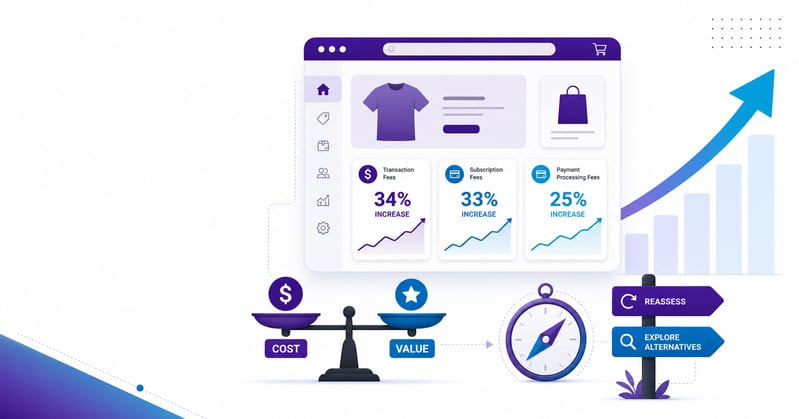
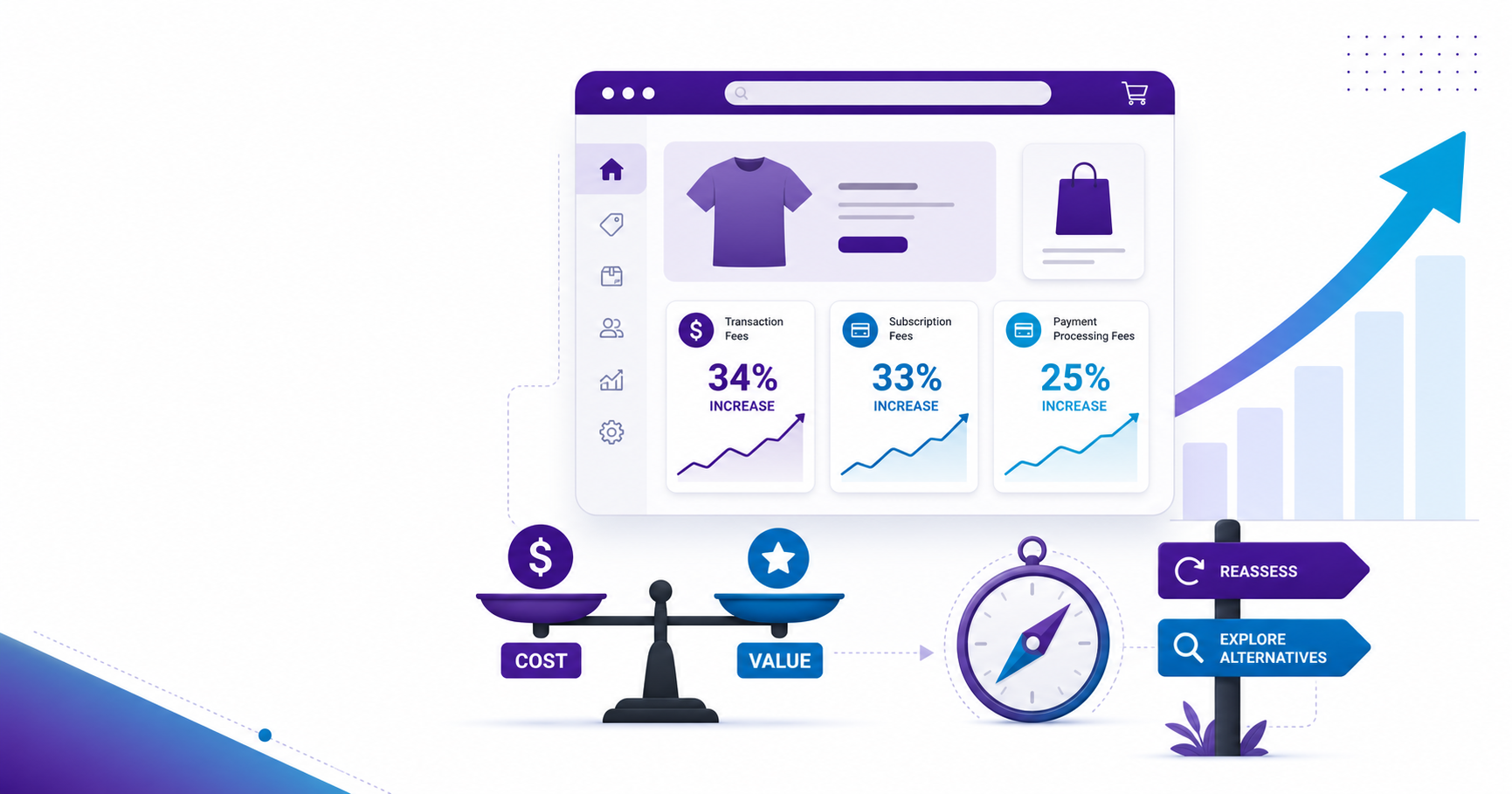
Shopify's 2026 Pricing Strategy: What the 34% Hike Means for Merchants. This article examines Shopify's substantial 2024-2026 price increases and plan restructuring, helping merchants evaluate whether the platform still delivers value for their business. As we navigate 2026, Shopify's pricing model has undergone significant transformation. What began as a 34.48% increase for the Basic plan in 2024 has evolved into a complete restructuring of the platform's pricing tiers — with the former "Shopify" plan now rebranded as "Grow" and enterprise costs climbing to new heights. With over 4.8 million businesses now operating on Shopify worldwide, the community is actively reassessing the total cost of ownership.
Analyzing the Price Adjustments (2024–2026)
The pricing landscape has shifted dramatically. The Basic plan jumped from $29/month to $39/month — a 34.48% increase. The standard Shopify Plan (now "Grow") rose from $79 to $105/month, representing a 32.91% increase.
| Plan |
Monthly (2023) |
Monthly (2024–2026) |
Annual (per month) |
Increase |
| Starter |
— |
$5 |
N/A |
New tier |
| Basic |
$29 |
$39 |
$29 |
+34.48% |
| Grow (formerly Shopify) |
$79 |
$105 |
$79 |
+32.91% |
| Advanced |
$299 |
$399 |
$299 |
+33.44% |
| Plus |
$2,000 |
$2,300–$2,500 |
Custom pricing |
+15–25% |
Shopify Plus pricing has risen from approximately $2,000 to between $2,300 and $2,500 per month, depending on contract length. Customers on longer, multi-year agreements may secure rates closer to $2,300, while shorter terms command the higher end of the range.
Annual billing now provides a 25% discount on Basic, Grow, and Advanced plans. Shopify also offers a promotional $1/month for the first three months after the free trial, lowering the initial barrier to entry.
The Full Cost Picture: Beyond the Subscription Fee
The subscription fee tells only part of the story. According to industry analysis, most merchants pay 2–3 times their base plan price once transaction fees, payment processing, apps, themes, and international selling costs are factored in.
Transaction fees hit hardest on the Basic plan: 2.9% + 30¢ per online sale via Shopify Payments, plus a 2% surcharge if you use a third-party payment gateway. These fees can be eliminated entirely by using Shopify Payments, which becomes increasingly important as revenue grows.
App spend varies widely by store complexity. Merchants often need multiple apps, with paid third-party apps typically costing $50–$100/month on top of the plan. Premium themes add another $100–$500 one-time cost.
At $100K+ annual revenue, total Shopify costs (plan + fees + apps) can run $400 to $800/month or more — significantly more than the plan price alone.
Impact on Businesses: Navigating Higher Costs
The price increases present a particular challenge for small businesses, raising fundamental questions about affordability and the overall cost-benefit balance of sticking with Shopify.
For growing merchants, the breakeven analysis has shifted. With the Basic plan at $39/month (2.9% + 30¢ per transaction) versus Grow at $105/month (2.7% + 30¢ per transaction), the upgrade becomes financially advantageous at approximately $8,000 in monthly sales — the point where reduced transaction fees offset the higher subscription cost.
The Advanced plan at $399/month (2.5% + 30¢ per transaction) becomes compelling at higher volumes. At $50,000 in monthly sales, moving from Grow to Advanced saves roughly $100/month in transaction fees alone, before accounting for the additional 15 staff accounts and custom reporting.
Staff Account Changes: Zero for Starter and Basic Plans
In a notable shift, Shopify has removed staff accounts from its Starter and Basic plans entirely. The Starter plan offers zero added user accounts. The Basic plan, which once permitted two staff members, now includes zero admin users.
This change complicates store operations for small businesses, forcing them to work within tighter constraints or upgrade to the Grow plan at $105/month to access five staff accounts.
Market Expansion Restrictions: Limited to Three
Shopify has drastically reduced custom markets from 50 to 3 for all non-Advanced plans. To surpass this limit, merchants must opt for the Advanced plan ($399/month) and incur an additional $59/month for each market beyond three.
This revision imposes a considerable constraint on businesses aiming to diversify their global reach and tailor offerings to multiple regions. The change not only affects scalability but also introduces a steep financial hurdle for those aiming to maintain or expand their international footprint.
The 2026 Competitive Landscape
As of 2026, Shopify and WooCommerce remain the twin heavyweights in the ecommerce CMS market. Shopify powers approximately 2.8 million stores with strong U.S. dominance (30% share), while WooCommerce leads in overall market share at 66.44%.
However, the pricing landscape has shifted. Key alternatives include:
| Platform |
Starting Price |
Key Differentiator |
| WooCommerce |
Free (hosting extra) |
Full ownership, flexibility, open-source |
| BigCommerce |
~$39/month |
No transaction fees, built-in B2B features |
| Wix |
$23/month (Business) |
Drag-and-drop ease, lower cost for small stores |
| Shopware |
Varies |
European alternative, increasing adoption |
| Adobe Commerce (Magento) |
Open-source free; enterprise custom |
Maximum control, self-hosted |
For merchants facing Shopify's rising costs, platforms like WooCommerce offer greater control and ownership, while BigCommerce provides comparable SaaS functionality without transaction fees. Self-hosted alternatives like CS-Cart, Shopware, and Medusa provide full source code access and extensive API integrations.
A Call to Reassess Your eCommerce Strategy
Shopify's sustained price increases — roughly 30–35% on main plans between 2023 and 2024, followed by the 2026 Plus restructuring — represent a fundamental shift in the platform's value proposition. What once was an accessible entry point for entrepreneurs now requires more careful financial planning.
The question is no longer simply "Can I afford Shopify?" but rather "Is Shopify the right long-term investment for my business model?"
Reevaluating Your eCommerce Platform?
If the recent pricing updates have you questioning your current e-commerce solution's value and scalability, contact Truvio today to book a 30-minute consultation. Our experts specialize in helping merchants find efficient, scalable alternatives tailored to your specific business needs, revenue model, and growth aspirations.
.svg "truvio_logo")