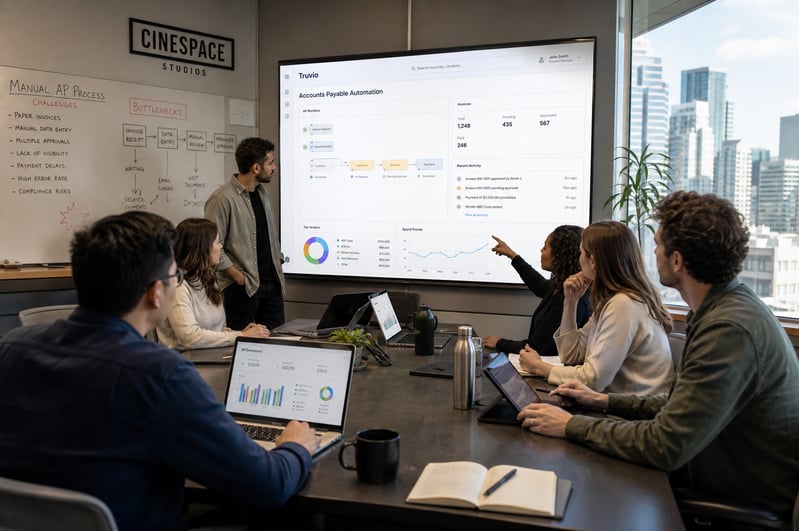
Rapid growth creates obvious pressure in the front office. More customers. More locations. More contracts. More complexity.
But the back office often feels the strain first.
For finance teams, that strain frequently shows up in accounts payable. Invoice volume increases. New entities are added. Approval paths become more complicated. Custom fields, purchase orders, vendor requirements, and local workflows start to multiply.
At first, manual AP still works. Invoices get entered. Approvals eventually happen. Payments go out. But as the business grows, the cracks become harder to ignore. Approvers lose track of requests. AP teams spend more time chasing status than improving the process. Finance leaders lose visibility into what has been approved, what is waiting, and what is coming due.
That was the challenge facing Cinespace Studios.
When Growth Outpaces AP
Cinespace Studios is a global film studio network with major hubs in Chicago, Toronto, Atlanta, Los Angeles, and international operations. The company supports some of the world’s most recognizable productions, including Stranger Things, The Bear, Black Panther, John Wick, The Handmaid’s Tale, and more.
Founded in 1988, Cinespace has grown from a family-run studio business into a global production platform with 109 active stages across 4.3 million square feet of production space.
Following a change in ownership and a period of acquisition-led growth, the company needed stronger financial controls and more scalable back-office operations. AP became one of the clearest places to modernize.
Before selecting Truvio, Cinespace was managing more than 10,000 invoices per year across multiple entities. But much of the process still depended on manual work. Invoices required hand signatures. Approvals were often routed outside the system. AP staff manually keyed invoice information into Microsoft Dynamics 365 Business Central.
Business Central helped the team check for duplicates, but it did not solve the broader workflow problem: approvals, coding, routing, visibility, and consistency.
“Sometimes we had to send invoices back to the same manager to approve because the approval never made its way to the AP team,” said Sasha Johnson, Corporate Controller at Cinespace Studios. “There are better things to do than approving the same invoice five times. It would delay when payments process for that vendor and could result in vendor relations issues.”
This is the part of AP inefficiency that often gets normalized. The duplicate approval request. The missing email. The invoice sitting with the wrong person. The approver switching between Teams, Business Central, and downloaded documents just to approve one invoice.
None of it looks catastrophic in isolation. Together, it becomes a drag on scale.
The Costs That Hide Inside Manual Approvals
Manual AP creates more than extra work. It creates structural problems that become more expensive as the business grows.
Approval delays. When approvals happen outside the system, finance teams lose control over timing. AP may not know whether an invoice is waiting for review, lost in an inbox, or already approved somewhere else.
Duplicate effort. Repeated approval requests waste time for AP teams and managers. They also create frustration for vendors when payment timing is affected.
Limited visibility. Without a centralized workflow, finance leaders do not have a clear view of invoice status across companies, entities, or locations.
Control gaps. As workflows spread across email, Teams, manual signatures, and ERP screens, approval trails become harder to follow and exceptions become harder to manage.
Scalability limits. Manual processes scale with people, not process. Every new entity, location, or acquisition adds more routing complexity unless the underlying workflow changes.
For Cinespace, these issues were not theoretical. The company was expanding quickly, managing multiple entities, and operating in a finance environment where custom Business Central fields and complex approval rules needed to be supported.
The finance and IT teams needed one procure-to-pay process that could support both purchase orders and invoices, work closely with Business Central, and simplify the user experience for AP staff and approvers.
What Good Looks Like: The Cinespace Studios Example
Cinespace evaluated several AP automation vendors, including purpose-built AP tools. The company brought AP staff into demos, interviewed approvers, and looked for a solution that could integrate directly with Business Central without requiring a custom-built integration.
The choice came down to Truvio and another AP tool with a more modern interface.
“It came down to us choosing between Truvio and a purpose-built AP tool with a much flashier UI,” said Jacob Wolfe, Director of IT at Cinespace Studios. “Ultimately, we chose Truvio because of seamlessness with BC and the fact that it had a lot of the benefits of a purpose-built solution.”
That distinction mattered. Cinespace did not want separate systems for procurement and payables. It wanted a more connected procure-to-pay process inside Business Central.
With support from the company’s partner, Admiral Consulting Group, Cinespace implemented Truvio AP Automation to support complex routing, custom Business Central fields, automated coding, document capture, OCR, approval hierarchies, and exception handling.
The implementation required alignment across Cinespace, Admiral, and Truvio. The team needed to define how invoices would flow through the approvals portal and into the Business Central back end while supporting the company’s custom fields and approval requirements.
“One standout was rapid customizations to Truvio and the initial portal,” said Ben Lane, Client Success Manager at Admiral Consulting Group. “Working closely with Jacob, we determined which pages and tables needed to be exposed and related to in the background.”
The rollout went smoothly, with positive feedback from both approvers and the AP team.
“The Truvio team was awesome and helped us with everything,” Johnson said. “Our rollout went pretty smoothly. We had nothing but positive feedback from approvers and from the AP team.”
Centralized AP Changes the Approval Experience
After implementing Truvio, Cinespace saw immediate improvements across its procure-to-pay process.
Instead of managing approvals across Teams, separate Business Central sessions, and manual document review, approvers now use one centralized dashboard. AP teams have better visibility into invoice status, fewer duplicate approval loops, and more consistent coding across recurring invoice types.
For Johnson, the difference was clear.
“For me as an approver, I’m loving it,” she said. “Previously it would come through our Teams account with each individual approval, maybe 10 a day, and I’d have to open each one with a BC session in a browser. I had to open a unique session of BC, download the document, then compare it to BC to make sure it was coded correctly, then go back to Teams to approve it. All told, it would then take 30 minutes to process. Now we have only one dashboard for every company. Putting it in one central location is so transparent for AP.”
That is what scalable AP looks like in practice. Not just faster invoice processing, but fewer places to check, fewer manual steps, and a clearer view of what is happening across the business.
Cinespace also improved consistency in coding. In one example, the Chicago office receives more than 50 property tax bills twice a year. After the AP team processed a few invoices, the system learned the pattern and helped process the remaining invoices more efficiently and consistently.
“It’s helped her because she doesn’t have to manually code them,” Johnson said. “Now, they all get coded the same way. That’s the feedback I get on how time is saved. It gives time to do other things like projects and has really streamlined the whole AP processing.”
The AP Problem Is a Scale Problem
The lesson from Cinespace is not simply that AP automation saves time. It is that AP processes designed for one stage of a business often break down at the next stage.
Cinespace’s original process made sense when the organization was smaller and less complex. But after new ownership, acquisition-led growth, multiple entities, and global expansion, the company needed something more scalable.
By moving AP automation inside Business Central with Truvio, Cinespace centralized invoice approvals, reduced manual processing, strengthened controls, and created a more consistent foundation for global growth.
It also created more flexibility. Instead of approvals going to one person with no easy way to share context, users can now add comments, forward invoices, and bring the right people into the process.
“It also gives us a lot more flexibility than before with approvals going to one person,” Johnson said. “For invoice approvals in the past there was no way to systematically share them. Now we can tag the invoice with a comment or forward it.”
As Cinespace continues to grow internationally, Truvio has become part of its long-term scalability strategy. After purchasing a company in Germany, Cinespace was able to bring the new subsidiary into a more standardized global AP system.
For Wolfe, the biggest impact is the time gained back for higher-value work.
“Time efficiency is one of the biggest benefits I see for a business using Truvio,” Wolfe said. “Saving time on manual data entry allows us to expand on our projects. Having more time to analyze the data they’re receiving and ask insightful and valuable questions, spot issues, and call them out helps AP teams and takes AP to another level.”
For fast-growing companies still managing AP through manual approvals, disconnected workflows, and fragmented visibility, the question is not whether the process will become a bottleneck. It already is.
The question is whether finance has the tools to redesign AP before the next stage of growth makes the problem harder to fix.
Truvio AP Automation helps organizations automate invoice processing, centralize approvals, and extend Microsoft Dynamics 365 Business Central with scalable procure-to-pay workflows. To see how it works for growing, multi-entity businesses, request a demo.
.svg "truvio_logo")