Days payable outstanding (DPO) is one of those metrics that looks simple on paper — divide average accounts payable by cost of sales, multiply by 365 — but managing it well in practice is a different matter.
Most finance teams understand the formula. What's harder is deciding what to do with the result. How long is too long to hold a payment? When does optimizing working capital cross into straining the supplier relationships your business depends on? And how do you keep DPO aligned with the broader financial strategy rather than treating it as a standalone number to push up or down?
This post covers the practical side of DPO management: how to set targets that actually make sense for your business, how to balance payables strategy with supplier trust, and how to build the monitoring habits that keep DPO useful over time. For a full breakdown of how to calculate DPO and the most common calculation mistakes to avoid, see our complete DPO guide.
Set DPO Targets That Reflect Your Business, Not Just a Benchmark
There's no universally correct DPO. Data from the American Productivity & Quality Center (APQC) puts the cross-industry average at around 40 days, but that figure means little in isolation. Apple runs at 82 days. Dell runs at 118. HP is closer to 137. All three are in the same industry, all three are financially healthy, and all three have arrived at very different approaches to managing payables.
The right target for your organization depends on three things.
First, where you sit relative to peers. Benchmarking DPO against companies of similar size in your sector tells you whether your current position is typical or an outlier. Medians and quartile ranges are more useful than single averages here — they show the range of what's normal, not just the midpoint. Manufacturers with large, complex supplier bases typically run higher DPO than service businesses with fewer vendors and faster cycles.
Second, your bargaining position with suppliers. Larger enterprises with significant purchase volume can often negotiate extended payment terms that smaller buyers can't. If your leverage is limited, pushing DPO too high simply means you'll be paying late against terms — which is not the same thing as strategic working capital management, and suppliers notice the difference.
Third, your growth trajectory. Practices that work at current scale may not hold when you're expanding into new markets or integrating new supplier relationships. Revisit targets when the business changes, not just on an annual cycle.
Don't Let DPO Optimization Come at the Cost of Supplier Trust
A common mistake in DPO management is treating payables purely as a lever for working capital without accounting for the relationship costs. According to a SAP survey, 51% of suppliers say buyers are typically late with payments. That's not a number to be comfortable with — late payments erode trust, and the downstream effects are real: tighter credit terms, reduced flexibility during supply crunches, higher costs over time.
There are three practical ways to manage this tension.
Track on-time payment performance as a separate KPI. DPO tells you the average; on-time performance tells you whether you're honoring the commitments you've made. A company with a DPO of 60 days and a 95% on-time rate is in a very different position than one with the same DPO and a 70% on-time rate.
Use early payment selectively, not universally. Some supplier relationships warrant early settlement — where early payment discounts are on offer, where the supplier is strategically important, or where paying early buys goodwill you'll need later. Blanket early payment reduces cash efficiency; targeted early payment is a relationship tool.
Be transparent when terms change. If cash flow pressures require extending payment cycles temporarily, communicating that directly to suppliers is far better than going silent. Predictability matters to vendors, even when the news isn't favorable.
Build Monitoring Into the Process, Not Just the Reporting Cycle
DPO is often reviewed quarterly as part of a financial review deck. That's useful for trend visibility, but it's not enough to catch problems before they compound. Monthly reviews give teams earlier visibility into shifts driven by seasonality, process bottlenecks, or changes in supplier terms.
What makes monitoring actionable is looking at DPO alongside the operational data that explains it. A rising DPO is worth investigating — is it a deliberate working capital decision, or is it invoices stuck in exception queues waiting for three-way match clearance? A falling DPO might reflect improved processing efficiency, or it might mean invoices are being paid early when they don't need to be.
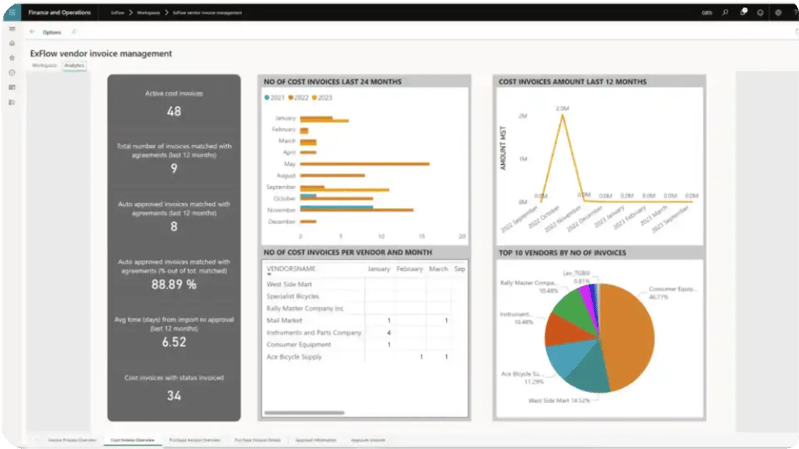
Dashboards that combine DPO with invoice processing timelines, approval cycle times, and exception rates give finance teams the full picture. For example, tracking how many invoices are on hold pending invoice coding corrections, or identifying patterns in which cost centers generate the most approval delays, turns a backward-looking metric into something forward-facing. And comparing across seasons year-over-year helps distinguish structural changes from cyclical noise — retailers will always see payables extend during peak season, and that shift shouldn't trigger alarm if it's expected.
Align DPO With Financial Strategy, Not Just Treasury Targets
DPO should connect to the broader financial plan, not sit as an isolated treasury KPI. When payables strategy is disconnected from budget planning and cash flow forecasting, the result is often a DPO target that looks good on a scorecard but doesn't actually serve the business.
Embedding DPO targets into the budgeting process ensures that payables assumptions are built into forecasts from the start, rather than treated as a lever to pull after the fact. Mapping expected disbursements against a 13-week cash flow view — factoring in the realistic timing of when invoices clear approval and reach payment — gives treasury a more accurate picture than average settlement terms alone.
There's also a credit consideration. Aggressively stretching DPO can affect borrowing relationships if it signals to lenders that the business is cash-constrained. Finance leaders managing credit agreements should assess how payables positioning reads externally, not just how it functions internally.
Finally, growth changes the calculus. A DPO target that preserves liquidity in a steady-state business may not be appropriate when entering new markets, onboarding new supplier networks, or running parallel AP workflows during a system migration. Payables strategy should flex with the business.
How Automation Directly Supports DPO Management
Most DPO problems aren't caused by bad strategy — they're caused by process friction. Invoices that sit unmatched because of missing purchase orders, approvals that stall because approvers are out of the office, payments that miss terms because no one flagged the due date in time. These are operational failures, and they distort DPO in ways that make it harder to manage intentionally.
Accounts payable automation software addresses the root causes. Automated invoice data capture using OCR reduces the manual errors that delay processing. Workflow-driven approvals route invoices to the right person automatically, with reminders that keep reviews moving without manual chasing. Real-time reporting surfaces which invoices are in exception, how long they've been held, and what's blocking resolution.
For organizations running Microsoft Dynamics 365, ExFlow integrates directly into Finance & Operations and Business Central to deliver this in a native environment — including automated invoice management, workflow-driven approvals, e-invoicing, vendor statement reconciliation, and AP reporting and analytics built for real-time visibility.
When the process runs cleanly, DPO becomes a genuine strategic lever rather than a number that's partly explained by invoice backlogs and chased approvals.
The Bottom Line
Managing DPO well means setting targets grounded in your actual industry position and supplier relationships, monitoring frequently enough to catch problems before they compound, and connecting payables strategy to the financial plan rather than running it as a standalone function.
The mechanics of calculation matter — get them wrong and the metric is misleading from the start. But the bigger opportunity is in building the operational discipline and tooling that lets you manage DPO intentionally, rather than discovering what it is at the end of each quarter.
Truvio's AP Automation powered by Exflow is a native Microsoft Dynamics 365 solution trusted by more than 5,000 organizations globally. To see how ExFlow can give your team real-time visibility into payables and reduce DPO, book a demo.
.svg "truvio_logo")