

Ecommerce SEO: The Complete Guide to Ranking Your Online Store
A practical ecommerce SEO guide for growing stores: site structure, product and category pages, technical SEO, multi-store setups and AI search, with a checklist.

Ecommerce SEO is the work of making an online store's category pages, product pages and content rank in search engines, so shoppers find the store when they search for what it sells. It covers keyword research, site structure, on-page optimization, technical SEO and structured data, and today also visibility in AI-generated answers.
For most online stores, organic search is one of the few channels that keeps delivering traffic without paying for every click. A well-optimized category page can bring in buyers for years. A badly structured store, on the other hand, can bury thousands of products where neither Google nor AI assistants will ever find them.
This guide covers ten strategies that work for any store, B2C, D2C or B2B. It then looks at what changes when a store grows: more storefronts, more languages, larger catalogs and product data spread across several systems. That is where many stores start losing rankings, and where the choice of platform starts to matter.
10 ecommerce SEO strategies that work in 2026
1. Do keyword research for category and product pages, not just blog posts
Most of a store's search traffic lands on category and product pages, so that is where keyword research should start. Category pages target broader terms with commercial intent, such as "women's trail running shoes". Product pages target specific, long-tail terms, such as a model name, a size or a part number.
Start here: map one primary keyword to each category page, so two pages never compete for the same term.
2. Build a flat, logical site architecture
A good store structure lets shoppers and search engines reach any product in a few clicks. A common rule of thumb is that important pages should be no more than three clicks from the homepage. A clear hierarchy also tells Google which pages matter most, as Google explains in its guide to ecommerce site structure.
Start here: organize the store as home → category → subcategory → product, with breadcrumbs and short, readable URLs.
3. Optimize category pages
Category pages are often a store's strongest SEO assets, because they match broad, high-volume searches. Many stores leave them as a bare product grid, which gives Google little to understand.
Start here: give every category page a unique title and H1, a short intro above the grid and helpful buying advice below it.
4. Write unique, useful product pages
Duplicate manufacturer descriptions are one of the most common ecommerce SEO problems. When hundreds of stores use the same text, Google has no reason to rank yours.
Start here: rewrite the descriptions for your bestsellers first, with complete attributes, specifications and reviews.
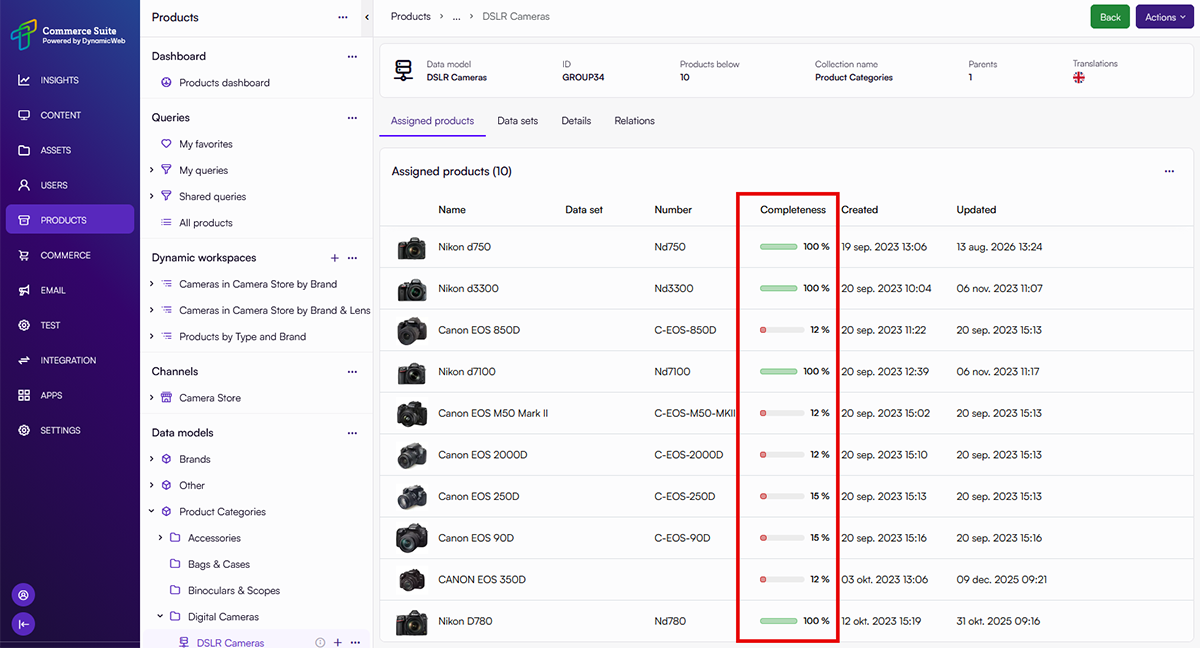
IN TRUVIO COMMERCE. The built-in PIM's completeness tracking flags gaps before products go live, so product data is enriched and validated before it reaches the site.
5. Add structured data
Structured data (schema markup) helps search engines understand your products and can earn rich results such as price, availability and review stars. It also makes it easier for AI systems to extract accurate product facts.
Start here: add Product and Offer schema to every product page, and ProductGroup markup for products with variants. FAQ markup is optional, since Google stopped showing FAQ rich results on May 7, 2026 (Search Engine Journal, May 2026).
IN TRUVIO COMMERCE. Product data is enriched once in the PIM, and pricing and inventory are read directly from Dynamics 365 in real time, so the data your markup is built from matches what the page shows.
6. Control faceted navigation
Filters for size, color, brand and price are great for shoppers but can create thousands of near-identical URLs. Without control, search engines waste crawl budget on filter combinations nobody searches for, while important pages get crawled less often.
Start here: let only filter combinations with real search demand be indexable, and keep the rest out with canonicals or noindex, following Google's guidance on faceted navigation.
IN TRUVIO COMMERCE. Structured, relational product data powers on-site search and filtering, which gives you clean attributes to decide which filter pages deserve to be indexed.
7. Make the store fast
Page speed affects both rankings and conversion. Google measures it with three Core Web Vitals: LCP (loading), INP (responsiveness) and CLS (visual stability). The thresholds are unchanged in 2026: LCP within 2.5 seconds, INP under 200 milliseconds and CLS under 0.1 (StudioMeyer, updated September 2026). Stores are often slowed down by large images, heavy scripts and third-party apps.
Start here: check Core Web Vitals for your category and product templates in Search Console, then compress images and remove scripts and apps you no longer use.
8. Set up multi-language, multi-currency and multi-store sites correctly
Selling in several countries or under several brands multiplies the SEO work. The most common mistakes are duplicate content across markets and missing or broken hreflang tags.
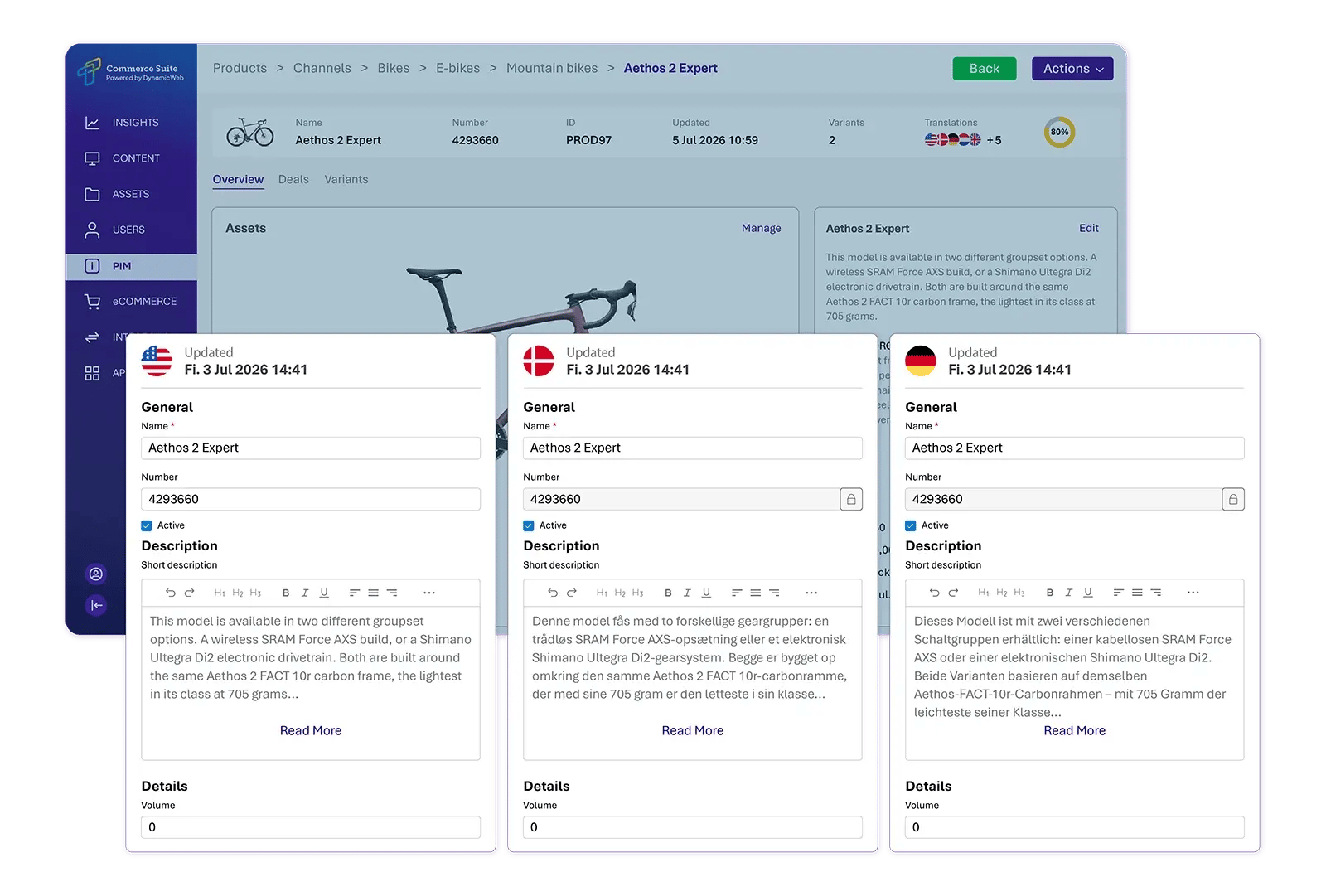
Start here: choose one URL structure per market, add hreflang tags, and localize titles and product texts, not just the interface.
IN TRUVIO COMMERCE. Multi-store capabilities let you add new markets, brands and channels as storefronts on one platform, with B2B, B2C and D2C running from a single codebase.
9. Create content that answers buyer questions
Shoppers search for advice before they search for products: how to choose, how to compare, how to use. Content that answers those questions brings in buyers earlier and builds links to the store.
Start here: collect questions from customer service, sales and "People also ask" in Google, and answer them in guides linked to the right products.
IN TRUVIO COMMERCE. Website content, landing pages, product pages and eCommerce run in one system, so buying guides and the products they recommend are easy to link together.
10. Get visible in AI search and AI Overviews
More and more buyers ask ChatGPT, Perplexity, Gemini or Google's AI Overviews for advice. These systems tend to cite pages that give clear, structured and trustworthy answers. Ranking well is no longer enough on its own: in an Ahrefs study of 4 million AI Overview citations, only 38% of cited pages ranked in the top 10 for the same query, down from 76% in mid-2025, as Google pulls more sources from related "fan-out" searches (Ahrefs, March 2026). AI is also starting to complete purchases: Google's Universal Commerce Protocol, launched in January 2026, lets shoppers check out directly in AI Mode and Gemini (TechCrunch, January 2026).
Start here: open key pages with a short, direct answer, and keep product facts identical across your site and feeds, including your Google Merchant Center feed, which is required for checkout in AI Mode and Gemini (eCommerceNews, January 2026). Video counts too: YouTube is the most cited domain in AI Overviews (Ahrefs, March 2026).
IN TRUVIO COMMERCE. Product data is managed once and published to every storefront, market and channel, including marketplaces and social platforms, so AI systems find the same facts wherever they look. See how Truvio eCommerce works.
When your store grows: the SEO problems that appear at scale
The ten strategies above work for any store. But as a business grows, new problems appear that are less about SEO tactics and more about how the store is built.
| As you grow... | ... this SEO problem appears |
| You add more brands or storefronts | Duplicate content across sites, and SEO settings managed in several places |
| You enter new countries | Missing hreflang, half-translated pages and wrong prices or currencies in search results |
| Your catalog reaches thousands of SKUs | Thin or missing descriptions, incomplete attributes and filter pages that explode in number |
| Product data lives in several systems | Product facts that differ between the website, feeds and marketplaces |
| Content and commerce run on separate platforms | Guides and product pages that are hard to link together, and two sets of SEO settings |
None of these can be fixed with a plugin. The fix is one structure for content, products and storefronts, and one source of truth for product data. A Product Information Management system (PIM) gives every product one master record and publishes the same enriched data to the website, marketplaces and feeds. For SEO, that means complete product pages, structured data built from clean fields, and the same facts for Google, marketplaces and AI assistants.
How your ecommerce platform affects SEO
Your platform decides how much of the work above you can actually do. Before choosing or replatforming, check that it lets you control these things without custom development:
| Capability | Why it matters for SEO |
| Editable URLs, titles and meta descriptions per page and language | The basics of on-page SEO |
| Canonical tags and indexing rules for filters | Prevents duplicate content and wasted crawl budget |
| Automatic structured data from product fields | Rich results and accurate AI answers |
| hreflang and multi-store management | Correct pages ranking in each market |
| Built-in redirects (301) | Keeps rankings when URLs change or you migrate |
| Fast templates and image handling | Core Web Vitals |
| CMS and commerce in the same system | Easy linking between guides, categories and products |
| PIM or clean integration to product data | Complete, consistent product pages |
Where Truvio Commerce fits
Truvio Commerce (powered by DynamicWeb) is our suite for eCommerce, Product Information Management (PIM) and Content Management (CMS). It supports B2B, B2C and D2C selling from a single platform and integrates natively with Microsoft Dynamics 365, so pricing and inventory are read directly from the ERP in real time.
The advantage of a unified platform is that content, product data and storefronts share one structure, connected to the ERP without middleware or third-party connectors to maintain. New markets or brands are added as storefronts rather than separate sites, and product data is maintained once instead of in several systems.
You might also like this

Commerce Partner Days 2026: Turning AI Into Partner Value
On September 9-11th, 2026, more than 100 partners from 16 countries gathered in Aarhus for Truvio Commerce Partner Days 2026 to explore the future of ...

What to Look for in Dynamics 365 Commerce Platforms: 8 Factors
If you run Microsoft Dynamics 365, you already know the uncomfortable truth about most ecommerce platforms: they weren't built for you. They were buil...

How B2B eCommerce Sellers are Growing Revenue with Personalization
Learn how B2B eCommerce personalization helps sellers grow revenue and gain more benefits. Get tips to personalize your eCommerce site. We've said it ...